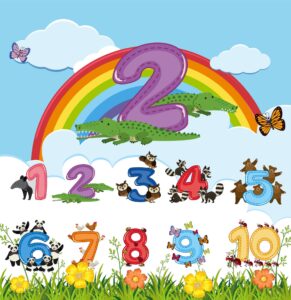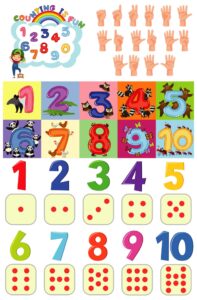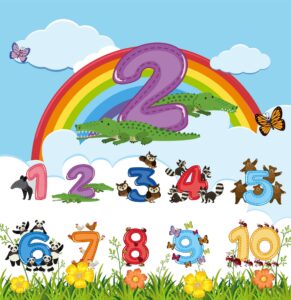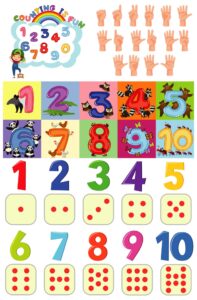
Number systems and operations
Number Systems and Operations – Summary
This topic introduces students to the different types of numbers and how they are used in mathematics. It forms the foundation for solving problems in algebra, geometry, and everyday life.
Students will learn about the main number systems, including:
Natural numbers (counting numbers)
Whole numbers (including zero)
Integers (positive and negative numbers)
Rational numbers (fractions and decimals)
Irrational numbers (non-repeating decimals like √2)
Real numbers (all rational and irrational numbers combined)
The topic also covers basic operations such as:
Addition
Subtraction
Multiplication
Division
Learners will understand how to apply these operations correctly using the order of operations (BODMAS) and how to work with fractions, decimals, percentages, and ratios.
By the end of this topic, students will be able to:
Identify and classify different types of numbers
Perform accurate calculations using various operations
Solve real-life problems involving numbers
Build a strong mathematical foundation for advanced topics
Natural numbers (counting numbers)
1. Definition
Natural numbers are the numbers used for counting objects. They are also known as counting numbers.
The set of natural numbers is:
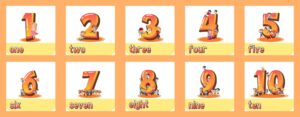
1, 2, 3, 4, 5, 6, …
They start from 1 and continue infinitely.
2. Key Features of Natural Numbers
They are positive whole numbers.
They do not include zero (in basic definitions).
They do not include fractions or decimals.
They do not include negative numbers.
They continue forever (there is no largest natural number).
3. Examples of Natural Numbers
1, 2, 3, 10, 25, 100, 1000
Real-life examples:
6 students in a classroom → 6 is a natural number
15 mangoes in a basket → 15 is a natural number
3 cars in a parking lot → 3 is a natural number
4. Uses of Natural Numbers
Natural numbers are used in everyday life for:
Counting objects (books, people, animals)
Ordering (1st, 2nd, 3rd positions)
Basic calculations (addition, subtraction, multiplication, division)
5. Operations with Natural Numbers
a) Addition
Natural numbers can be added to get another natural number.
Example: 4 + 3 = 7
b) Subtraction
Subtraction is only valid if the answer remains a natural number.
Example: 9 − 5 = 4
But: 3 − 7 is not a natural number
c) Multiplication
Multiplying natural numbers gives another natural number.
Example: 5 × 2 = 10
d) Division
Division is only valid if the result is a whole number.
Example: 12 ÷ 3 = 4
But: 7 ÷ 2 is not a natural number
6. Representation on a Number Line
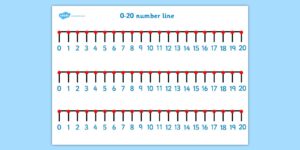
Natural numbers can be shown on a number line starting from 1 and increasing to the right:
1 → 2 → 3 → 4 → 5 → …
Each step represents an increase of 1.
7. Important Notes
Natural numbers begin from 1, not 0.
They are part of a larger group called integers.
They are the foundation of mathematics, especially for beginners.
8. Comparison with Other Number Types
Natural numbers: 1, 2, 3, 4
Whole numbers: 0, 1, 2, 3
Integers: … -3, -2, -1, 0, 1, 2, 3
9. Summary
Natural numbers are the basic counting numbers starting from 1. They are used in everyday life to count, order, and perform simple calculations. They are positive, do not include fractions or negative values, and continue infinitely.
0/1